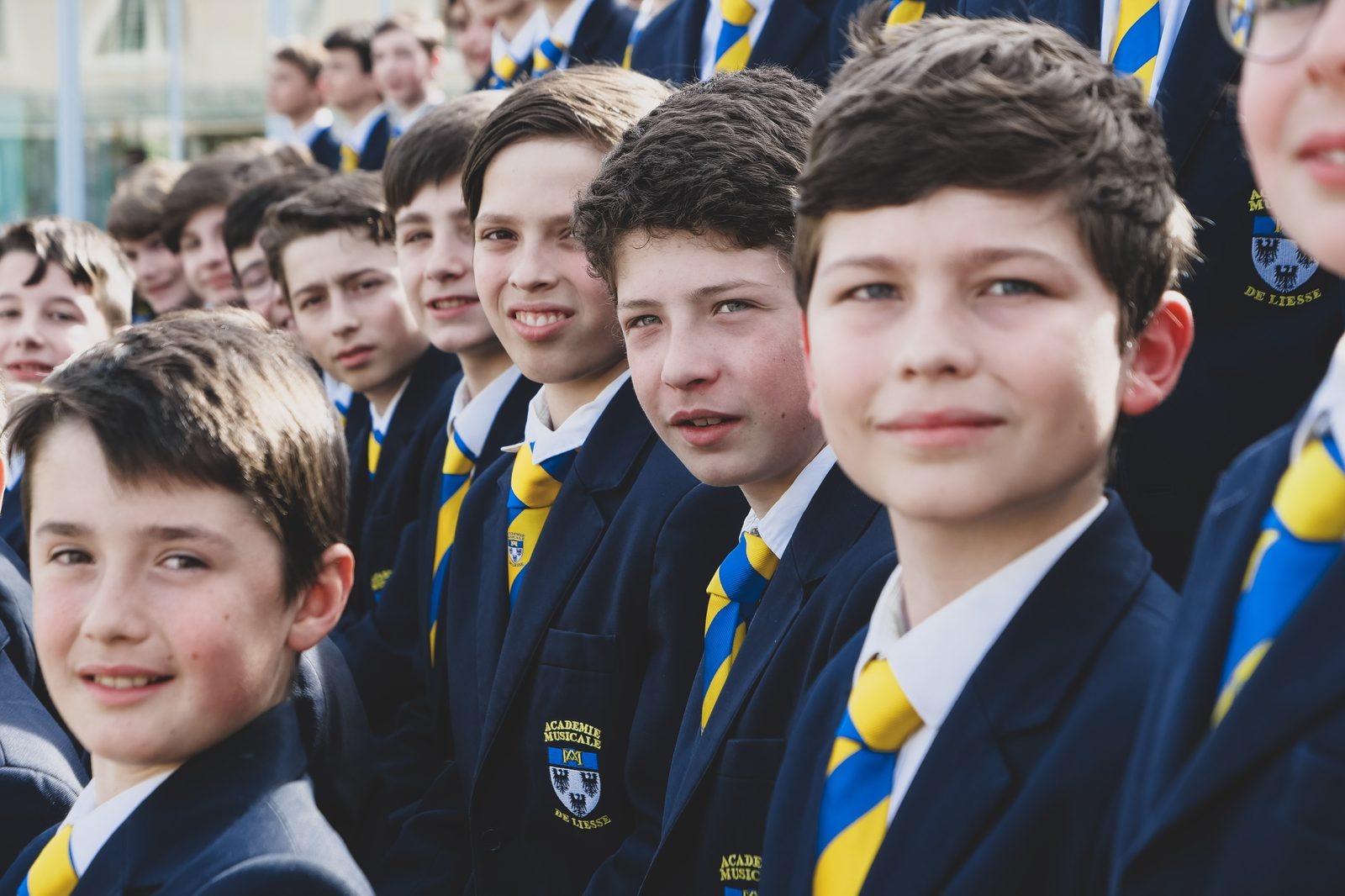
The protection of each child entrusted to us is the absolute priority of the headmaster and of the educational team. It comes before every other concern or interest.
To translate this commitment into daily life, the Académie Musicale de Liesse has adopted a Safeguarding charter, signed by all parents of students and by all adults working within the school: teachers, employees, volunteers, members of the governing board, choir directors, music teachers, regular visiting staff, priests. It applies both at the Academy and outside school, at weekends and during the holidays.
This charter draws on the pedagogy of Don Bosco, characterised by family spirit, kindness, trust and respect for each person. It seeks to guarantee each child an atmosphere of protection, safety and calm, in a spirit of transparency and professionalism towards parents and the relevant authorities.
“The safety of each student comes before every other concern. This charter is intended to be preventive for students as for adults, without preventing us from living fully the family spirit that must characterise us.”
The charter is structured in eight sections covering every aspect of the students’ life within the school and beyond it.
Students, parents and staff are required to know and to observe the charter. The headmaster, with the educational team, is the guarantor of the moral and physical safety of each person.
Adults undertake always to work in pairs or teams, with mixed staffing (men, women, couples), to treat each child with dignity and respect, and to avoid any situation in which they would be alone with a minor in an isolated place.
The required preventive notices are on display throughout the year (charter, school rules, 119, the French child-protection helpline, emergency numbers).
The Academy observes all French fire-prevention standards that apply to premises that accommodate minors overnight (ERP with sleeping quarters).
Daytime and night-time fire-evacuation drills and PPMS drills (the national school emergency plan) are carried out more often than the law requires.
In the event of immediate danger, the boy is taken in charge at once by the relevant authorities. A boy whose behaviour endangers his safety or that of others may be summoned before an educational council.
All new employees and volunteers provide an official criminal-record certificate (bulletin n° 3) before starting work; it is requested again each year from the whole educational team.
The headmaster may require an interview with the diocesan psychologist, in accordance with the recommendations of Catholic Education for boarding structures.
Adults care for each child selflessly and appropriately, without favouritism. No personal gifts, and no unapproved one-to-one lessons. No adult lends his telephone or his computer to a student.
To avoid any risk of undue influence, adults may not take on other roles in a student’s life (sacramental godfather or godmother, etc.).
Students are not admitted to the private areas of the Academy, in particular the community building. Individual lessons and interviews take place in partly glazed rooms, with the door open; by default, students are received in groups of two at least.
Sanctions meet four conditions: advice from the educator, an explanation to the student, proportionality to the offence, and good sense and kindness. Physical or verbal outbursts are strictly forbidden, as are collective punishments.
In bedrooms, dormitories and washrooms, only the educators on duty are authorised to enter. The night supervisor never remains alone with a student, and the arrangement of the furniture favours maximum visibility from the entrance.
Bus journeys are provided by private coaches driven by professional drivers. During journeys, students sit beside students and adults beside adults.
No journey alone with a student outside the grounds is authorised without a prior request to the headmaster; these occasions must remain exceptional.
Students from CM1 to 4e only go out accompanied. Those in 3e and lycée students may move about in pairs in Précigné according to their timetable.
During tours, educators may sleep in the same dormitory as the students, but with a minimum of five students, and an independent bed set apart. Any activity outside Précigné is supervised by at least two adults.
During weekends and holidays, employees and volunteers do not organise outings for groups or for boys on their own; any exception requires the prior written authorisation of the headmaster and of the parents.
The use of social networks is not authorised within the school; adults and students undertake not to exchange through these networks.
Any taking of photographs or video of students is subject to the explicit agreement of the headmaster; no recording may be published or stored on a private medium without authorisation.
Computers connected to the internet are placed in a room in view of all, for professional purposes or for academic or musical work.
Any recurring correspondence between an adult and a student requires the prior agreement of the parents and of the headmaster.
A programme of human formation and of formation in affective and sexual life is in place, in keeping with the Christian vision of man and of sexuality, and in particular with the Theology of the Body of St John Paul II. It is articulated around three complementary approaches:
The students’ commitments also appear in the school rules as displayed:
Because the truth always sets us free, students are invited to report any failure to observe these principles and may at any time reach their parents on the school’s landline telephones, or call the 119 listening service.
Each summer, the headmaster and his team draw up an annual review sent to the executive committee of the managing association.
An annual meeting, before the start of the school year, gathers all the adults working at the Academy: observance of the charter over the past twelve months, feasibility, areas for improvement, and case studies.
A second annual meeting is devoted to raising awareness among parents.
This charter is intended to be preventive for students as for adults. Observing it does not stop anyone from fully living the family spirit that must characterise us, nor the educational ideal of St John Bosco, who invites us to a disinterested, professional and universal relationship towards each of the young people entrusted to us.